
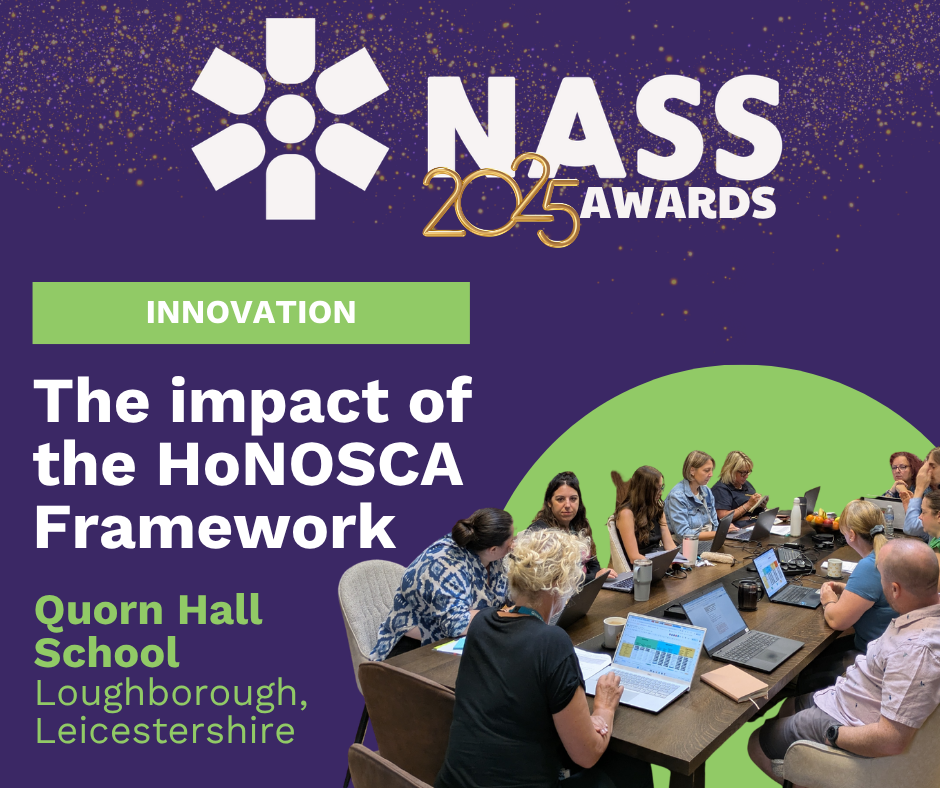
 Quorn Hall School, an independent special school in Leicestershire, was a 2025 NASS Award finalist in the Innovation category for its pioneering use of the HoNOSCA mental health framework to deepen understanding of pupil needs and transform whole-school practice. The school caters for children and young people with social, emotional and mental health needs, many of whom have additional special educational needs and diagnoses such as autism and ADHD. By moving from observing behaviours to clinically informed insight, the school has created meaningful change that is improving wellbeing, learning and belonging for every student.
In this guest blog, Anna Fitzpatrick, Deputy Headteacher and Head of Therapy, shares her reflections on how the HoNOSCA framework is changing lives, and how a therapeutic, evidence-led approach is helping students truly thrive.
---------------------------------------------------------------------------------------------
Moving from Observing to Quantifying through a therapeutic lens and how the HoNOSCA Framework is Changing Lives at Quorn Hall.
At Quorn Hall School, our vision is simple: “we believe in learners until they believe in themselves” but how do we turn that belief into a practical, day to day reality? The answer lies in a powerful mental health framework called HoNOSCA (Health of the Nation Outcome Scales for Children and Adolescents).
While the name sounds clinical, the impact is deeply human. By using this framework, we’ve moved from subjective opinion of what a child needs to "knowing" with clinical precision and through a therapeutic lens.
The "Whole-School"
The real magic of HoNOSCA isn’t just the data, it's the collaboration. At Quorn Hall School we need a “live” understanding of our pupil’s worlds. That is why our Multi-Disciplinary Team MDT) meets every single week with one clear aim to ensure that every pupil in every class is scored every single term. The success of the HoNOSCA framework lies in the sheer breadth of expertise around the table. Our team consists of our Head of Therapy, Art therapist, OT, SaLT, SENDCo, Headteacher and our Assistant Heads for Behaviour and Quality of Education. As well as representatives from the Family Support and Safeguarding teams and our attendance officer. Each member brings a wealth of hard evidence from their specific areas, collating data from termly reports, token trackers, incident logs, clinical observations/reports and safeguarding concerns.
Because we use a shared baseline scoring process, we’ve created a space where teachers, therapists, and support staff share insights that used to live in separate silos. We are learning about aspects of our children’s lives that we never knew before, the hidden "whys" behind their educational journey.
Seeing the Big Picture and the Small Details.
As the person leading these meetings and diving into the data, I get a unique "bird’s-eye view" of each area of the school. This data allows us to be incredibly responsive to the individual needs of the child, where we catch shifts in anxiety or emotional symptoms early, intervening before a child hits a crisis point. The data also guides us to look more deeply at what might be underlying these shifts so we can make changes, such as adapting their classroom environments to reduce arousal or moving class groups to grow a greater sense of belonging and last but not least to the needs of the staff, we don't just guess what training we need, the data tells us exactly what specific interventions our staff need to be experts in.
Turning the Dial on Behaviour
When we first started scoring, two things jumped off the page, disruptive behaviour and lack of concentration and attention. We didn’t just add more rules, we added more support. Our Occupational Therapist (OT) helped us launch Sensory Circuits, which are now available to every pupil across three dedicated areas in the school. Whether a child needs calming, alerting or organising, we have a space for them. We’ve even tidied up our approach by training our own staff. One of our Positive Relationship Mentors is now a Sensory Inclusion Facilitator (SIE Trained), whilst another leads the Mulberry Bush Curriculum, which works hand in hand with our sensory work.
Staggering results after one year! HoNOSCA scores told us that there was a
- 45% Reduction in disruptive, aggressive and antisocial behaviour
- 36% Reduction in overactivity and inattention in class.
- 25% Improvement in problems with peer relationships including online interactions
Our whole school behaviour data confirms this and told us that there was a
- 35% Reduction in the need for physical interventions (RPIs).
- 45% Reduction in incidents between pupils
Bridging the Gap: Education meets Wellbeing
We’ve also linked this clinical data to the classroom through our Token Tracker which has been developed and improved alongside the introduction of HoNOSCA to ensure it provides valuable data. This monitors attendance in class and engagement, but it also tracks how well pupils are living out our values of being Responsible, Reflective, Resilient, and Respectful. If a child is struggling with a specific subject, we don’t just look at their academic ability. We look at the HoNOSCA data to see if there is an underlying emotional or sensory reason for the struggle.
The Journey Ahead
Building this framework to suit Quorn Hall specifically has taken patience, but the "buy-in" from our whole staff team has been the key to its success. We aren't just a school; we are a therapeutic community where data helps us see the child behind the behaviour.
----------------------------------------------------------------------------------------------------
Watch a short video about Quorn Hall School's use of the HoNOSCA Framework: https://youtu.be/DY-L_nb16Uc
To read about our other 2025 NASS Award finalists and winners, please visit: https://nasschools.org.uk/announcing-our-2025-nass-award-winners/