
DfE has issued updated guidance on the use of reasonable force and other restrictive interventions in schools, replacing the previous 2013 framework. Restrictive interventions, including use of reasonable force, in schools comes into force in April 2026 and clarifies legal duties, promotes transparency, strengthens safeguarding obligations and emphasises reducing restrictive practices.
For special schools and settings supporting pupils with SEND, the guidance addresses particularly sensitive and complex scenarios. This article highlights the key legal implications and practical considerations for specialist provision.
Legal thresholds and duties
1. Legislative context
The guidance must be read alongside the statutory framework. It complements section 93A of the Education and Inspections Act 2006, which governs lawful use of force in schools, and the Schools (Recording and Reporting of Seclusion and Restraint) (No. 2) (England) Regulations 2025, which set out recording and reporting duties.
The statutory element of the DfE guidance is limited to the use of force recording and reporting requirements (pp. 14–15). The rest is non-statutory, but schools are expected to have regard to it and justify any departure from its recommendations.
2. Updated terminology
The guidance introduces clearer terminology to improve consistency:
- Use of force / significant use of force / significant incident – any instance where force exceeds what would normally be appropriate.
- Seclusion – preventing a pupil from leaving a space physically, securing the space, or creating a belief that leaving will lead to punishment.
- Restraint / immobilisation – holding or binding a pupil, securing them to a fixed object, or removing an auxiliary aid used for mobility.
Schools must apply these statutory definitions when determining whether an incident meets recording or reporting thresholds.
3. Lawful use of force
Staff may only use reasonable force to prevent harm, property damage, criminal behaviour, or disorder. Force must be proportionate, applied for the shortest time, and never used as punishment.
Prohibited practices include anything that interferes with breathing or circulation (e.g., pressure on neck or abdomen, covering mouth/nose). If a pupil is taken to the ground unintentionally, they should be repositioned safely, and medical assessment sought where appropriate.
In special schools, inconsistent application of thresholds may expose institutions to claims of negligence, safeguarding failures, discrimination under the Equality Act 2010, or breaches of Articles 3 and 8 of the Human Rights Act 1998.
4. New legal duties from April 2026
All schools must:
- Record every significant incident (significant use of force).
- Record all seclusion or restraint incidents, regardless of severity.
- Report incidents to parents as soon as reasonably practicable, ideally the same day.
Special schools require robust recording systems, clear internal processes, and transparent communication with parents to ensure compliance.
What schools should ensure is included in current processes
- Review and update policies to reflect revised terminology and thresholds, including pre-agreed interventions in behaviour support plans.
- Ensure records capture not only name, date, time, location, but also relevant needs (including SEND), rationale for force, injuries, and post-incident support.
- Apply clear distinctions between reporting and record sharing. For a significant use of force not involving seclusion or restraint, parents must receive a report of the incident, but the written record itself does not need to be provided. Where the incident involves seclusion or restraint, the 2025 Regulations require that parents be given a copy of the actual written record.
- Scrutinise “safe spaces” and “calm rooms”; if pupils cannot freely enter or exit, this may legally constitute seclusion.
- Train staff to apply legislative definitions consistently and adopt a cautious approach to mitigate safeguarding, equality, and legal risk.
Safeguarding, prevention and de-escalation
The guidance prioritises prevention and de-escalation. Schools should develop a restrictive interventions policy that aligns with behaviour policies, emphasising proactive strategies to reduce the need for force.
Staff must be trained not only in lawful force but also in de-escalation techniques and trauma-informed practices. Positive behaviour cultures help address underlying causes of challenging behaviour, particularly for pupils with SEND.
What schools should ensure is included within their current processes
- Active oversight of restrictive practice data by governing bodies.
- Analysis of trends to meet legal and safeguarding obligations and identify areas for improvement.
Tailoring support to individual needs
Many pupils with SEND display behaviours that challenge due to sensory overload, pain, anxiety, or communication barriers. Non-verbal pupils are particularly at risk of restrictive interventions.
Special schools should understand individual triggers, use staff who know pupils well, and implement risk assessments to reduce the need for restrictive interventions. Strategies may include de-escalation, environmental adjustments, and communication support.
Behaviour support plans should be co-produced with pupils, parents, and professionals, documenting adjustments and when increased physical contact may be appropriate. Plans must be reviewed after significant incidents to ensure effectiveness.
What schools should ensure is included within their current processes
- Strengthen staff training on de-escalation, trauma-informed practice, and lawful use of force.
- Analyse data to identify disproportionate use of restrictive interventions and evaluate placement appropriateness.
- Review and co-produce behaviour support plans, setting clear parameters for physical contact.
- Implement robust risk assessments and review them after significant incidents to ensure continuous learning.
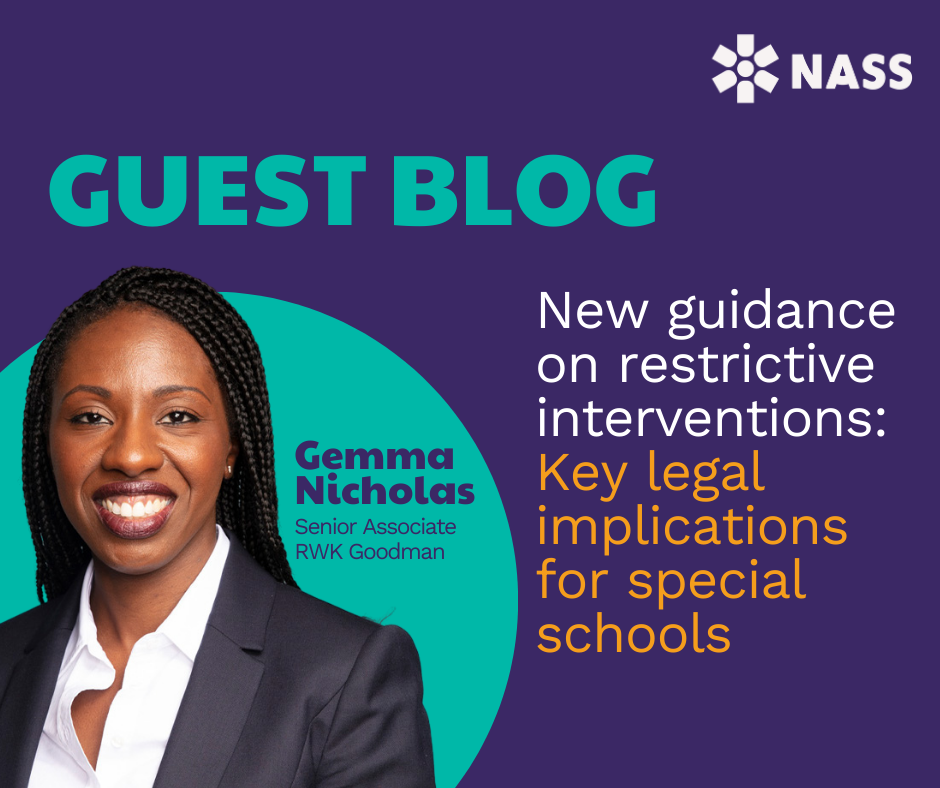
Gemma Nicholas is a Senior Associate at the law firm RWK Goodman, which is a NASS Partner.
Need support? RWK Goodman’s children services team can support schools in preparing for the April 2026 changes, offering guidance on compliance with the new legal requirements. Get in touch: gemma.nicholas@rwkgoodman.com