
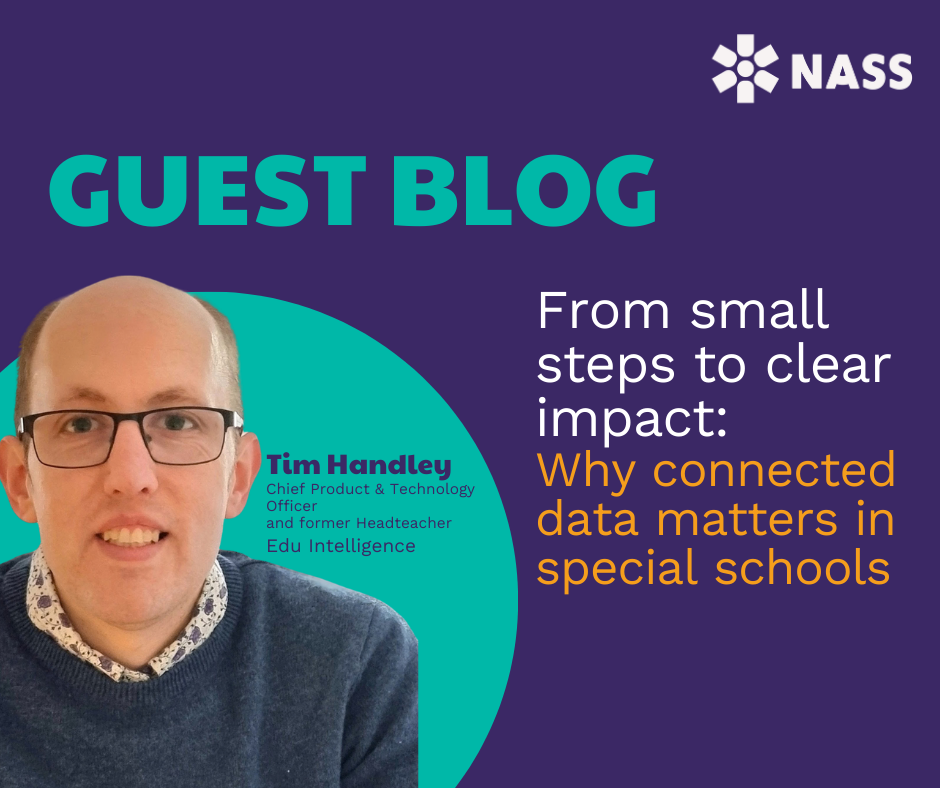
Guest blog by Tim Handley, Chief Product & Technology Officer, Edu Intelligence from Welbee
Making sense of information held across multiple systems and using it to evidence what's working
In a specialist setting, some of the most meaningful progress happens in the “small steps”. You see it when a pupil manages a transition without distress for the first time, or when a non-verbal learner uses AAC to express a preference.
Leaders and staff don’t miss this progress. You are experts in it. The challenge is to clearly evidence impact, showing what drove the change, and using that evidence confidently in inspection conversations, annual reviews, and decisions about provision.
And that's where things get harder. Because the evidence is often spread across multiple systems and documents. Pulling it into a single, connected story takes time and, even then, the full picture can often feel just out of reach.
The evidence is there. It's just fragmented.
Special schools are not short of data. If anything, there's more of it than in mainstream settings, and much of it is richer and more detailed.
Some sit in policies, procedures and plans: EHCPs, improvement plans, annual review notes, therapy reports, multi-agency updates. This is where the strategic intent lives, the agreed approaches and the professional reasoning behind provision decisions.
Alongside that sits operational data: attendance patterns, behaviour logs, communication assessments, safeguarding records, incident logs, staff information.
Each system tells part of the story. But without a joined-up view of how it all relates, leaders end up relying on partial snapshots or spending hours trying to connect the dots by hand.
The pieces are there. They just don't speak to each other.
The cost of disconnection
This fragmentation has real consequences for leaders, for staff, and ultimately for children.
Lost time
In many special schools, leaders spend hours each week acting as manual data processors. CSV exports. Cross-referencing spreadsheets. Trawling notes to build a picture for a review or inspection. This isn't strategic work, it's administrative friction. Every hour spent stitching data together is an hour not spent in classrooms, not supporting staff, not working with families.
Missed connections
When data is siloed, we lose the narrative of the whole child. A behaviour incident gets recorded as dysregulation, but the pattern behind it stays hidden because the causes are scattered across different systems.
Perhaps the dysregulation clusters around arrival times, or transition-heavy days, or periods of transport disruption. Perhaps it correlates with sensory overload at lunch, or weeks when agency staffing is higher. Perhaps communication gains have stalled because AAC use isn't consistent across all staff or settings, but that inconsistency only shows up if you can see training records, timetables and progress data together.
The problem is that spotting these connections requires someone to have the time to pull information from multiple places and piece it together manually. Most leaders, understandably, don't have that time. So, we end up responding to symptoms, not causes.
Harder to evaluate interventions
A strategy might show early promise and then fade. It might work with one cohort but not another. But if the evidence sits in separate places, you won't spot that quickly. You're left pulling reports and trying to work out whether something is actually working or just feels like it is.
Widening what we mean by "data"
The term "data" in education has often just meant the numbers in the MIS. But a school's intelligence isn't only rows and columns. It's also in the text.
EHCPs, improvement plans, annual review notes, therapy reports, Ofsted feedback, policies. These documents contain vital context. In a disconnected system, they sit in a shared drive, divorced from daily operational data. But the questions teachers and leaders face is: Is this intervention working? Are we making the progress we expected? What's changed? can only be answered properly when the narrative and the numbers come together.
Staff stability is part of the provision
In specialist settings, workforce stability isn't separate from provision. It directly affects consistency, relationships, and regulation. Children who need predictability are most affected when staffing is unstable.
But many leadership teams only see this through lagging indicators: sickness patterns, escalations, exit interviews. The problem with exit interviews is simple. They're useful for hindsight, but too late for prevention.
When staff voice, operational pressures, incident patterns, and timetable pinch points can be seen together, it becomes easier to spot where pressure is building and why. Not to "predict resignations,” but to identify early enough to act, so teams feel supported before dissatisfaction turns into departure.
What would "good" data connectivity look like?
Imagine being able to ask: Where is progress accelerating or stalling and what's changed around it? Or: Which interventions are having the intended impact, and where are they not?
Not as a reporting request that takes days. As something you could explore in minutes, with the evidence already connected.
The goal isn't to replace professional judgment with dashboards. It's to back your expertise with joined-up evidence, so you can make confident decisions about what to keep, adapt, or stop, and walk into an inspection, a review, or a commissioning meeting knowing you can show clearly what's working and why.
The question for leaders
The Education Secretary spoke at BETT this year about a "data-driven school system" and a new "data spine" designed to unlock insights "trapped in closed systems." The recognition is there at policy level: we cannot improve outcomes if our intelligence is locked away in silos.
For special schools, this matters even more. Small cohorts make statistical trends harder to read. Progress is often non-linear and highly individual. The evidence that matters most is frequently qualitative. All of this makes connected intelligence, the ability to see narrative and numbers together across systems, not a nice-to-have, but essential.
The question for leaders is no longer whether this is achievable, but how quickly we move from scattered information to clear, connected insight.
Because when we connect the data, we don't just save time, we see the child more clearly. And as educators, that is what matters most.
Edu Intelligence helps special schools and specialist trusts bring all their information into one place and then understand what it is telling them. It connects directly to a school’s MIS, bringing together data such as assessment and progress, attendance, behaviour, wellbeing and inclusion. Schools can also upload key documents, including inspection reports, frameworks, improvement plans and policies.
Edu Intelligence analyses everything together, showing leaders what drives outcomes for pupils with SEND, where pressures or patterns are emerging, and what to focus on next. Unlike other systems, it goes beyond reporting by recommending clear, evidence-based next steps and helping schools measure impact and progress over time. This gives SEND leaders a clearer picture, reduces time spent on manual analysis, and provides strong, up-to-date evidence for inspection, governors and wider accountability.
Edu Intelligence is a NASS partner and to find out more about its special offer for NASS member schools, please contact: sarah@edu-intelligence.ai