
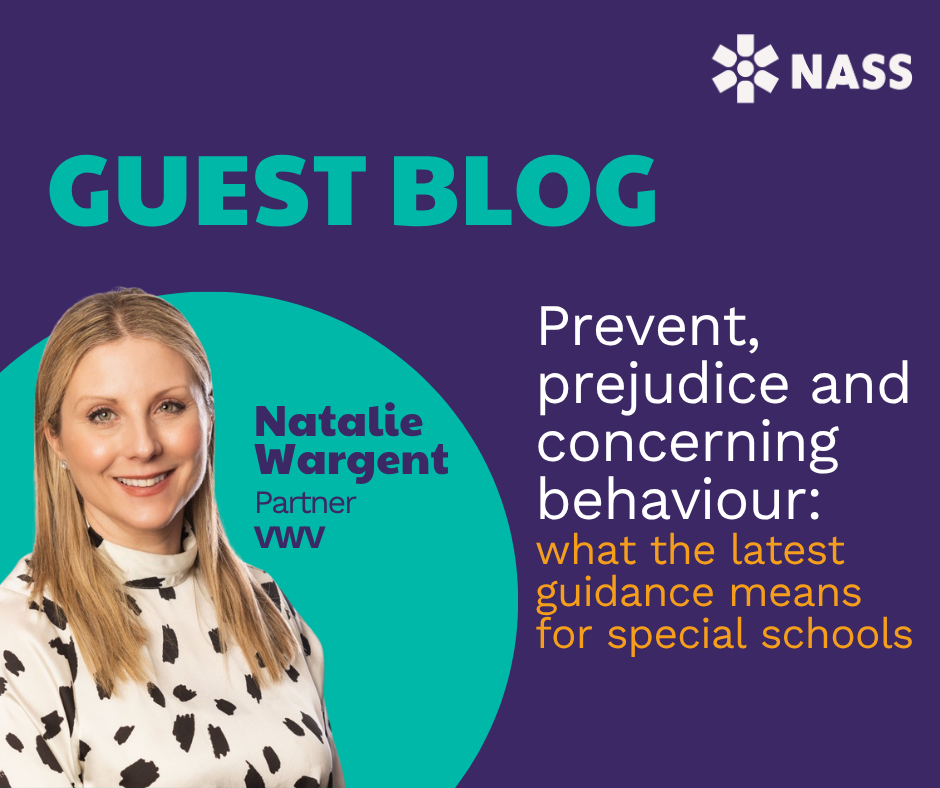
 The latest changes to the Department for Education's Prevent guidance may be relatively brief, but they raise important questions for schools about how safeguarding concerns are identified, assessed and responded to.
In this guest blog, Natalie Wargent, Partner at VWV Law, examines the updates and the wider lessons for special schools, including the importance of understanding behaviour in context, exercising professional judgement and ensuring that concerns are neither overlooked nor misinterpreted.
-------------------------------------------
On 2 October 2026, the Department for Education (DfE) updated its Prevent duty: practical guidance for designated safeguarding leads, introducing two additions to the section on concerning behaviours: fixation with weaponry or explosives, and antisemitism.
Although relatively brief, the changes raise important questions for schools about identifying and responding to potential radicalisation, particularly where a pupil's behaviour may have several possible explanations.
The amendments also come against the backdrop of significant scrutiny of the Prevent system, most notably following the Southport attack in July 2024, and heightened concern about antisemitism in the UK.
For special schools, the updated guidance reinforces the importance of understanding behaviour in context, exercising professional judgement and ensuring that safeguarding concerns are neither overlooked nor misinterpreted.
Lessons from Southport: recognising risk beyond ideology
The addition concerning weaponry and explosives is particularly significant in light of the findings of the Southport Inquiry.
The inquiry examined the circumstances leading up to the attack in July 2024, in which three young girls were murdered. Its Phase 1 report, published in April 2026, identified serious systemic failings in how the risks posed by the perpetrator, Axel Rudakubana, were understood and managed.
Rudakubana had been referred to Prevent on three occasions between 2019 and 2021, but none of those referrals progressed to a Channel panel. The subsequent Prevent Learning Review identified weaknesses in how concerns were assessed, particularly where an individual displayed a fascination with extreme violence but did not demonstrate a clear extremist ideology.
The Southport Inquiry also highlighted wider failures in information-sharing, risk assessment and multi-agency working. Crucially, it found that professionals had, at times, attributed concerning behaviour to Rudakubana's autism, rather than sufficiently recognising and responding to the risks he posed.
These findings are particularly relevant to special schools. They demonstrate the dangers of what is sometimes described as diagnostic overshadowing: where concerning behaviour is explained primarily by reference to an individual's diagnosis, potentially obscuring other safeguarding risks.
This does not mean that autism, neurodivergence or SEND should be regarded as indicators of radicalisation or violence. They are not. Rather, the lesson is that a pupil's needs and diagnosis must inform safeguarding assessments without becoming a substitute for them.
The government's response to the Southport Inquiry expressly committed to strengthening Prevent guidance and training, including introducing training for those working with learners with SEND.
Against that background, the October amendment is particularly relevant. The guidance now identifies a fixation with weaponry or explosives, including posing in concerning photographs or videos with weapons, without an otherwise reasonable explanation, as a potential indicator of radicalisation.
Importantly, the guidance also makes clear that an individual does not need to demonstrate a clear or identifiable ideology for a Prevent referral to be appropriate.
Together, these provisions reinforce the importance of considering patterns of concerning behaviour and potential risks, rather than relying solely on evidence of an established extremist ideology.
Antisemitism: understanding the boundaries of Prevent
The second amendment concerns antisemitism and comes amid heightened concern about antisemitic incidents and attacks in the UK.
The terrorist attack at Heaton Park Hebrew Congregation synagogue in Manchester on 2 October 2025, and subsequent incidents targeting Jewish communities, have brought renewed attention to the threat posed by antisemitic extremism.
The government's wider response has included measures intended to strengthen security, address antisemitism in education and tackle the spread of extremist narratives.
However, the DfE's amendment draws an important distinction. It expressly states that antisemitism, in itself, is not necessarily a Prevent concern.
Prevent is concerned with identifying individuals who may be susceptible to being drawn into terrorism or supporting terrorism. Prejudice or discriminatory behaviour, however serious, does not automatically indicate such a risk.
Nevertheless, the guidance recognises that antisemitism can form part of extremist and terrorist ideologies, including some forms of Islamist and extreme right-wing terrorism. Where antisemitic beliefs or behaviour form part of a wider extremist worldview that may contribute to radicalisation or support for terrorism, a Prevent referral may be appropriate.
For schools, this distinction is important.
An antisemitic comment or incident must be taken seriously and addressed through appropriate safeguarding, behaviour and anti-discrimination procedures. However, it should not automatically be treated as evidence of radicalisation.
DSLs should consider the wider circumstances, including whether the pupil is expressing entrenched extremist beliefs, repeating language encountered elsewhere, being influenced by harmful online material or demonstrating other concerning behaviours.
The central question is whether there is evidence of susceptibility to radicalisation, rather than prejudice alone.
What does this mean for special schools?
The updated guidance is particularly relevant to the professional judgements that DSLs and school staff make when interpreting pupils' behaviour.
Special schools have detailed knowledge of their pupils' individual needs, communication styles, interests and behavioural presentations. This expertise is invaluable in identifying when behaviour may be concerning and determining an appropriate response.
However, the Southport findings demonstrate why schools must be careful not to explain away potentially serious concerns solely by reference to a pupil's SEND.
Equally, there is a risk of over-identifying Prevent concerns where behaviour may have an entirely different explanation.
For example, a pupil may have an intense and longstanding interest in military history, weapons or historical conflicts. Another may repeat offensive language encountered online without fully understanding its meaning or implications.
Neither situation automatically indicates radicalisation.
For DSLs, relevant questions might include:
- Is the behaviour new or escalating? Has the pupil's interest, language or presentation changed significantly, or is it consistent with their established interests and behaviour?
- What is the wider context? Are there other concerns, such as threats of violence, harmful online influences, social isolation or expressions of extremist beliefs?
- How does the pupil understand their behaviour? Could communication differences, literal interpretation or difficulties understanding social situations be relevant?
- Are concerns being considered collectively? Do separate incidents, viewed together, suggest a pattern that may not be apparent when each is considered in isolation?
- Is specialist input needed? Would consultation with SEND professionals, safeguarding partners or Prevent practitioners help inform a proportionate assessment?
These considerations should help schools avoid both under-identifying genuine risks and unnecessarily treating pupils' individual needs or interests as indicators of radicalisation.
Looking ahead
The October amendments may be relatively modest in length, but they reinforce an important principle: effective safeguarding depends on understanding the individual, recognising patterns of concern and making proportionate, evidence-informed decisions.
The lessons from Southport are a reminder of the importance of professional curiosity, effective information-sharing and sustained oversight of concerns. The antisemitism clarification similarly reinforces the need to distinguish between different forms of harmful behaviour and identify the most appropriate safeguarding response.
Ultimately, the updated guidance is not about lowering the threshold for concern or encouraging unnecessary referrals. It is about helping DSLs make better-informed decisions, ensuring that pupils receive appropriate support and that risks to pupils and others are properly understood and addressed.
Further information
Schools can access the DfE's Prevent duty: practical guidance for designated safeguarding leads, updated on 2 October 2026, alongside the Southport Inquiry Phase 1 report and the government's response to its recommendations.
VWV Law is a NASS partner and its experienced education lawyers provide expert legal advice on governance, compliance, safeguarding, funding, and operational matters, ensuring that special schools can focus on delivering exceptional education and care. >> Find out more