
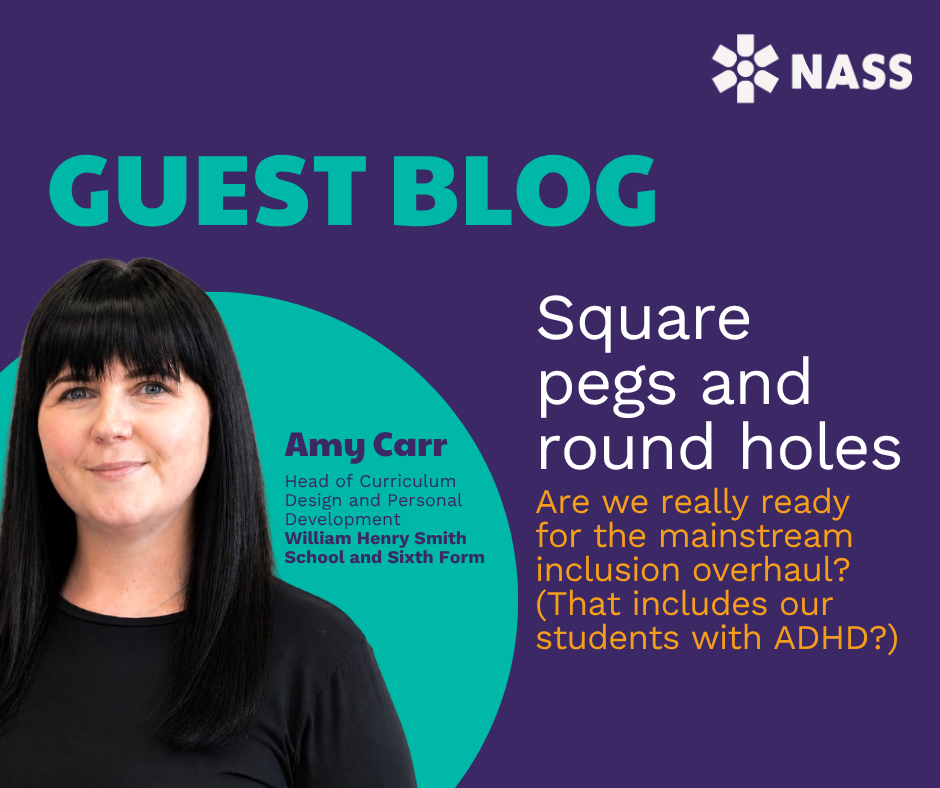
 Amy Carr is Head of Curriculum Design and Personal Development at William Henry Smith School and Sixth Form, a non-maintained specialist residential school for children and young people aged 5–19 with complex SEMH needs.
Earlier this year, Amy’s research paper 'Square pegs, round holes' was published. Her research amplifies the voices of young people with ADHD in the north of England, highlighting how rigid school routines and behaviour policies can intensify symptoms and contribute to exclusion. Through qualitative interviews, students described feeling misunderstood, pressured to “fit”, and often unsupported, pointing to the need for more flexible, inclusive approaches in mainstream education.
In this guest blog for NASS, Amy reflects on her research and shares one of its strongest messages: the simplicity of what young people are asking for - “be nice, be kind, and be patient.” Many of those she spoke with described a lack of empathy, limited recognition of their strengths, and few positive relationships within school. As she writes in her blog: "Before we start thinking about interventions and high-quality teaching, we need to strip it back. Relationships first."
Amy also reminds us that, as schools continue to navigate inclusion and SEND reform, the voice of the child must remain at the forefront of practice.
--------------------------------
With the biggest ever reforms set out for our SEND students, the spotlight now sits within our mainstream provisions to be the first port of call when it comes to inclusion. But are we really equipped in our schools, our culture and our mainstream education system to provide the inclusive practice set out in the current whitepaper?
I ask this question, because all too often, I’ve seen first-hand the impact that a performative, rigid, archaic system has on all students, but particularly children with ADHD. Regardless of how far we’ve come in our understanding of SEND, and more recently, neurodivergence (Sonuga-Barke et al, 2023), I just can’t help but feel our ADHD children are still getting a bad deal.
Please don’t just take my word for it. Take the children’s word for it.
I want to take this opportunity to share the voice of students with ADHD, their experiences, framed in research, to highlight the complexity, and importance of getting this right.
My recently published paper ‘Square pegs, round holes’explores the experiences of young people with ADHD, their experiences in mainstream education and their suggestions for making things better. Reassuringly, their suggestions are not some elaborate framework or intervention. It’s something as educators, in and amongst the systems and performativity, we might just have forgotten about.
It’s important to take a step back and look at where we’re at with ADHD research, especially if we want to understand the challenges students are still facing in mainstream schools and how this links to current SEND reforms. The idea of students with ADHD as “square pegs in round holes” has been around for a long time (Gallichan & Curle, 2008) and has since been used more widely across SEND (Morgan & Costello, 2023). The fact we’re still using it over 20 years later says a lot—too often, the system still expects young people to change, rather than adapting around them. Research points to a mix of stigma, lack of staff training, and a strong biomedical, deficit-focused view of ADHD as key issues. When you think about it, being labelled as having a “disorder” at a young age—and then being removed from class for struggling with things like attention or movement—can really shape how a child sees themselves and how others respond to them.
There’s also clear evidence that ADHD is viewed more negatively than other needs (Brown & Fisher, 2023; Carr-Fanning, 2024). Studies have found that peers (and even parents of peers) are less likely to want to befriend a child with ADHD (Varma & Wiener, 2020; Krtkova et al., 2022; McDougal et al., 2023), and that children can be seen as responsible for their behaviour in a way that isn’t applied to other conditions (O’Driscoll et al., 2012). Teacher perceptions matter too—those with a more positive understanding of ADHD are more likely to use supportive strategies, whereas those who see it as a problem within the child are less likely to adapt their practice (Gaastra et al., 2020; Giannakopoulos, 2025). This is why the direction of the current white paper feels so important. If we’re serious about inclusion in mainstream schools, it’s not just about systems and policies—it’s about making sure students with ADHD actually feel wanted, understood and valued. Right now, the research suggests many don’t, and that’s the gap we still need to close.
Persistent Disruptive Behaviour- Exclusion and ADHD
Persistent Disruptive Behaviour is still the most common reason for exclusion in England. I want to explore the links between this, and the presentation of unmet ADHD needs. Can we say we will create successful inclusive schools, as part of a ‘universal’ offer when we are punishing students for talking in corridors? Or forgetting pens? Research, and the voice of the students, suggest that rigid behaviour policies significantly impacted their sense of inclusion. This doesn’t mean that we don’t hold high expectations for all students, but instead of handing out punitive punishments for things an ADHD brain might struggle with, we use these opportunities to build relationships, and a sense of support.
Research Results
In summary, the students who were part of my study described feeling like “square pegs” who simply don’t fit. Many reported strained relationships with both teachers and peers, often believing they are disliked or treated differently because of their diagnosis. This led to exclusion in different forms—from missing out on trips to being formally excluded from school altogether—leaving them with a strong sense of injustice and rejection. These experiences were reinforced by school structures that prioritised uniformity over difference; rigid timetables, inflexible teaching approaches and behaviour policies that blur the line between ADHD traits and “disruption”, resulting in punishment rather than support. They feel that staff lacked the training or understanding to support them effectively, and that their strengths—like humour, creativity or energy—were overlooked in favour of academic conformity.
Rather than adapting the system, students often feel pressured to “adapt themselves”, with medication sometimes positioned as the main solution to help them cope. While this can be helpful for some, others felt it came at the cost of their identity, highlighting the need for more holistic and inclusive approaches. Encouragingly, the students themselves offered clear, practical ideas for change: more flexible routines, movement breaks, smaller classes, better-trained staff, and a stronger focus on relationships, strengths and listening to their voices. These insights closely align with the direction set out in the whitepaper, which emphasises strengthening inclusion within mainstream schools, improving staff training, and creating environments that meet diverse needs earlier and more effectively. Put simply, the message is clear—rather than expecting students with ADHD to fit the system, it’s the system that needs to change to fit them.
Out of all my research findings, three words and recommendations came up the most. ‘Be nice, be kind, and be patient’. Too many of the children I interviewed talked about a lack of empathy, recognition of strength, understanding of their needs and any positive relationships. Before we start thinking about interventions and high-quality teaching, we need to strip it back. Relationships first. Our children with ADHD need to feel liked and wanted in your classroom. Only then, can they start to learn.
I also want to take this opportunity to say, that I feel for colleagues in mainstream. It’s also important to acknowledge the pressure they’re under. They’re already juggling high expectations, constant scrutiny, and increasingly heavy workloads, often with limited time and resources. Alongside this, the expectations set out in the new SEND reforms place even more responsibility on them to meet a wider range of needs within the classroom. While the aim of greater inclusion is absolutely the right one, it’s hard to ignore the reality that many teachers are being asked to do more without always being given the training, capacity or support needed to do it well.
I’d like to leave you with some of the key quotes from my study. They’re thought provoking, speak volumes, and tell us everything we need to think about while navigating this period of implementation. We must keep the voice of the child at the forefront of our practice.
‘They just saw, like…they just, I don’t know how to explain it, but yeah, they weren't very kind to me because of what, because I've got ADHD?’.
‘You know, I just got given my work and told here, do it, rather than, you know, sitting down and actually going through with me and breaking it down’.
‘If I did something wrong, it was straight on the phone and be like pick him up, you know nothing to do in mean time. It was just sat outside reception waiting for my parents to pick me up, and then next day it started again’.
‘Yeah, like I've always had my humour, you know? But you know, at the end of the day, it sort of gets pushed aside all your strengths in mainstream because you know, everything's focused on their learning’.
‘Because they always ask me how my days been. Them, they didn't even ask you how your day's been’.
When we ask ourselves if we are ready for an inclusion haul at a universal level, I hope we can consider the above points, and ensure our mainstream provisions get the right support to be inclusive for all students, in our culture, our policies and understanding.
------------------------------------------------------------------------------------------------------------------------
You can read Amy's research paper here: ‘Square pegs, round holes’—A qualitative case study investigating pupils with attention‐deficit hyperactivity disorder and their perception of barriers to inclusion in classrooms in the north of England