
 The publication of the Schools White Paper and SEND Reforms consultation raises important questions for the specialist sector.
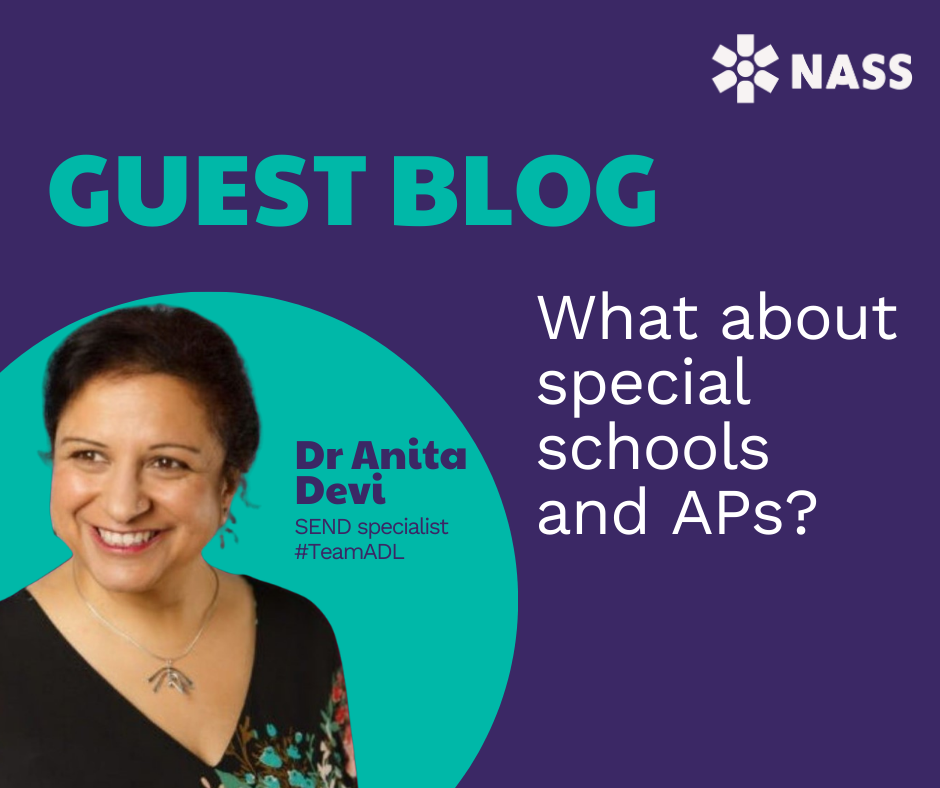
In this guest blog, Dr Anita Devi FRSA CL dr.h.c. (GGA) reflects on three key areas for special schools and Alternative Provision (AP): defining ‘Provision for All’ in special schools and AP, clarifying their offer and layers of support, and ensuring the sector maintains a clear identity and boundaries as policy evolves.
She also highlights practical steps settings can take to prepare, including the ‘Train the Reviewer for Provision Reviews’ programme delivered in partnership with NASS, which supports special school and AP leaders to define and evidence their ‘Provision for All’.
---------------------------------------------------
The long-awaited Schools White Paper 2026 is out! A week prior to its publication, NASS CEO Claire Dorer OBE and myself wrote an article for TES. Within it, we discuss ways in which special schools and APs can demonstrate 'their inclusive practice’ in relation to inspection frameworks and as well as broader outreach work. The Schools White Paper is in the consultation phase and there is much to dive into and ask the ‘so what?’ question and/or ‘what are the consequences of this recommendation /action?’
In this short editorial, I seek to highlight three areas that come to the forefront for me:
1) Defining ‘provision for all’ in special schools and AP
Ordinarily Available Provision (OAP) is a term that I am not fond of; nonetheless, it has been used in the White Paper. Historically, my team has used the term “Provision for All” in reference to the community the setting serves. Sadly, in the White Paper, OAP is referenced only in relation to mainstream schools. What about special schools or APs?
In my experience of working across the sector in a variety of schools, and supporting initial teacher training in special school environments, all special schools and APs have OAP. It is part of their school culture and ethos. It is the teaching delivery that defines their pedagogical approach in the classroom with students who have a range of needs and combinations of need, including Autistic Spectrum Condition (ASC), Speech, Language and Communication Needs (SLCN), Social Emotional Mental Health (SEMH), Severe Learning Difficulties (SLD) and Profound & Multiple Learning Difficulties (PMLD).
Moving forward, therefore, I believe it is imperative that special schools and APs define their ‘Provision for All’ - what makes them distinctive, what they do, how they do it, and the impact it has for their community.
2) Defining offer and layers of support
Page 11 of the White Paper places an expectation on special schools, APs and special post-16 institutions to have a clearer focus on outreach. This is a concerted effort to share services and information with others in their community.
In my experience, outreach can be both pro bono and a traded service. Given some of the funding challenges ahead and the distance outreach may need to cover, it is possible that a mixed model may be adopted. It is still unclear if, within a Trust, this would be an expected part of participation.
Either way, effective commissioning will be required. What is the host school asking the special school or AP to provide through outreach? How will impact be measured? What challenges may occur in this type of commissioning model regarding legal responsibility, capacity and clarity?
Therefore, I would argue that having clear documentation of what a special school or AP offers at a universal level, and additionally, is going to be crucial. The special school/college and AP sector will need to define their own layers of support. Figure 4 on page 27 of the White Paper is mainstream-centric, and given that in some instances special schools and APs are required to be the ‘Experts at Hand’ (i.e. targeted plus and specialist for mainstream), where will specialist sector education providers get their support?
3) A clear identity and boundaries
The legal principle of ‘presumption to mainstream’ is being proposed with regard to parental preference (p70), and the law is planned to be amended for LAs to provide a recommended list for Specialist Provision Packages (SPP). What isn’t clear is how needs will be matched to the provision available.
Special schools and APs need to be ready to stand their ground on such recommended lists—both from a perspective of ‘here is what we can offer’ and ‘this is what we cannot do’. This is not about creating barriers or a binary system. It is about boundaries. All healthy systems and relationships recognise the need for identity and boundaries.
Some of the recommendations in the White Paper were foreseen, and some are logistically ill-thought through. This is why in late Autumn 2025, NASS partnered with TeamADL to deliver our one-day accredited ‘Train the Reviewer for Provision Reviews’ online course. We have already delivered the training to a first cohort of NASS members. Feedback has been very constructive, and those who completed the training are now undertaking their own review to produce their ‘Provision for All’ document. This is a great tool for communicating with parents and for managing expectations.
The review methodology used in a Provision Review is robust, based on clear theories of change and research methodology. It has been used by settings across the country for decades. The training covers the background to the review and equips those who attend to lead their own review annually with stakeholders. It is a person-centred process, giving those who lead in special and AP settings a structure for constructive conversations about growth and clarity with their school communities. The review process itself takes a day, and for the one-day training we insist on two people from each setting attending.
This is a time to act or sit back and watch others prepare for what is coming. At this stage, it is hard to tell how entrenched the recommendations from the White Paper will be, and whether the consultation will have any impact. All the recommendations have been costed, and some have begun. However, the multiple consequential outcomes of change at this scale have either not been evaluated through a risk assessment, or the risk assessment has not been publicly shared.
Now is the time to get ready. We look forward to welcoming you to the two half-day online training sessions scheduled for 29th April and 6th May 2026. You can sign up here: https://forms.gle/PBKdy8RZQUMLyN3HA
Footnote: If you are a special school or AP in a trust, the Provision Review methodology could be an approach to unite inclusive practices across a trust, as the same methodology can be applied contextually to both mainstream and special settings.